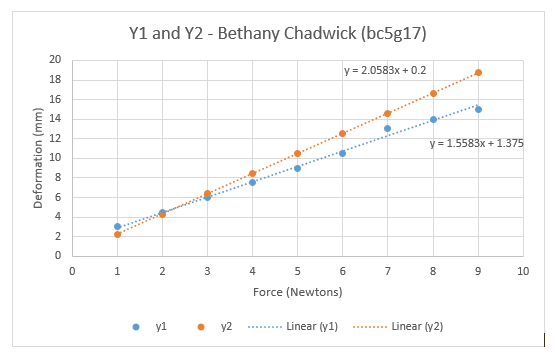
INTERSECT:
Estimate from looking at the graph: x = 2.5
Simultaneous equations:
(1): y= 2.0583x + 0.2
(2): y= 1.5583x +1.375
Solve:
(2) – (1): 0 = 0.5x – 1.175
X = 2.35 N
Substitute x into (1):
Y = (2.0583*2.35) + 0.2
Y = 5.04 mm
Thus, when 2.35 N of force is applied to materials Y1 and Y2; both are ‘stretched’ by 5.04 mm.
Although both the estimated and theoretical values for x are similar, the difference between the values shows that it is important to calculate the intersect using simultaneous equations rather than estimating by viewing the graph.
WHAT IS HAPPENING PHYSICALLY?
Both of the materials in this graph display a positive linear relationship, this coincides with Hooke’s Law; . This means that both materials are still in their elastic regions.
However, as both materials have different gradients (material Y1, and material Y2, ), when force is applied, material Y2 deforms faster than Y1.
Furthermore, initially Y1 has a higher deformation than Y2 (up until the intersection). Inferring that when an initial force is applied to material Y1 it deforms more than Y2, despite this, Y1 has a much slower rate of deformation and therefore does not ‘stretch’ as fast as material Y2.

 Do all materials comply with Hooke's Law?